

















Breast Augmentation with Implants
Content
Description
Breast augmentation with implants (augmentation mammaplasty, breast enlargement or enhancement, sometimes “boob job” ) is a surgical method that involves the insertion of silicone implants to improve the shape or increase the volume of the breasts.
The implant can be inserted either under the mammary gland or under the pectoral muscle.
The skin incision can be made under the breast crease, under the areola, or under the armpit, but it can also be placed in the navel area (in this case, however, a solution-filled implant must be used).
However, the procedure itself must be preceded by a consultation to match the patient's ideas with possible options and the doctor's opinion.
Facts
- General anaesthesia
- Outpatient procedure/Hospitalization for 1-2 days
- Surgery takes 1-2 hours
- Recovery 2 weeks
A suitable candidate for breast augmentation with implants is a woman who has underdeveloped breasts or a reduced mammary gland due to breastfeeding or significant weight loss.
The surgery and the implant itself allows breastfeeding afterwards, but during pregnancy and breastfeeding the volume and the shape of the breasts change and breast sagging may occur with the need for an aesthetic solution.
Implants are made in different sizes to be used for different types of chests.
Importat are:
- The width of the implants
- The height of the implants
- The prominence of the implants
These three parameters then decide the total volume (the size), which is given in cm3 (cubic centimeters-ccm).
The size of the implants is therefore measured for each woman individually according to the size (height and width) of her chest and the quality and quantity of her skin and mammary gland.
There are several manufacturers of implants, the best quality ones are American, German and French.
The basic type of implants are silicone implants, which are made of inert silicone and their surface is either smooth or rough (textured). Textured implants are much more common today for their better fixation in the desired position.
The shape of the implants is either semicircular or drop-shaped (anatomical). Semi-circular implants create a plumper décolleté, while anatomical implants look more natural.
The second type are implants formed by a silicone cover and filled with a saline solution. The saline solution is filled during operation and for this type of implants it is also possible to use approaches through the armpit and abdomen (by inserting a rolled implant, which is then filled and leveled).
The last type are polyurethane implants, which have similar properties to silicone implants, but are light-weight.
A consultation with a plastic surgeon is required before the planned surgery. The aim of this consultation is to choose the right type of implant, the shape of the implant as well as the appropriate size. The surgical approach and the resulting scar will be consulted.
- The surgery is performed under general anaesthesia, therefore a pre-operative examination is required.
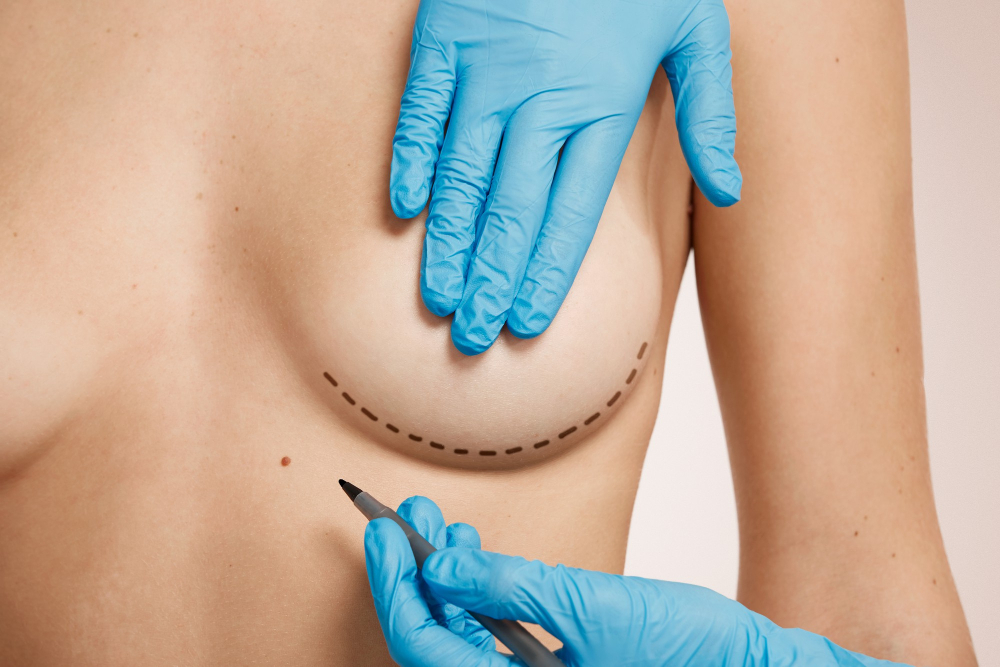
- The planed incisions are marked prior to the operation.
- Post-operatively Redon drains are usually used.
After the surgery, the breast shape is maintained with an elastic bra for 6 weeks and it is recommended to sleep on the back for a month after the surgery and to limit sporting activities or other strenuous activities.
The stitches that were used to close the wound are then removed 12 to 14 days after the procedure.
Breast augmentation with implants involves certain risks and possible complications.
These include:
- Wound dehiscence (opening of the surgical wound) with expulsion of the implant.
- Seroma or hematoma (fluid or blood formation around the implant).
- Changed nipple sensitivity.
- Breast asymmetry.
- Capsular contracture and capsule-calcification.
- Others.
The advantage of breast implants is immediate breast augmentation, which leads to higher self-confidence and a fuller décolleté or improved breast shape.
The results are immediate and complications are quite rare.
The effect of breast augmentation is permanent until the weight and proportions of the patient's breasts do not change (e.g. breasfeeding).
However, it is possible that after about 10 years:
- Due to a change in the quality of the implant, it may tear (implant rupture).
- A capsular contracture is formed and a replacement should be considered.
It is important to wear an elastic bra for 6 weeks after the surgery.
Avoid physical activity (like swimming) for at least the first two months.
Use a moisturizing cream in the case that the skin or nipples are dry.
Showering the breasts is recommended only when the wound has healed.